3D Scan of Carved Ivory Sculpture
Some time ago I had the chance to take out our new handheld laser scanner and explore an auction house here in
Los Angeles. The plan was to see how easy it would be to scan and catalog part of their inventory. I chose
this location because it specializes mainly in Chinese art so they would have tons of small and intricately carved
artifacts. This was a great way to test the Handyscan’s capabilities.
The first item that looked interesting was this statue carved from ivory. The piece stood about 40 cm tall and had no shortage of intricate shapes and minute details. Having scanned similar pieces in the past with both a structured light scanner and a Nextengine laser scanner I knew this would be no easy task.
What would have taken me easily three hours in the past now took only fifteen minutes. The 7 crossing laser lines quickly captured most of the surface except for small sections that couldn’t be seen by both sensors simultaneously. To solve this the scanner has the option to switch to just one laser line. With this option the line needs to be seen by only one camera. This allows me to reach into and capture the small nooks and crannies such as underneath the arms, behind the fish and legs, etc. … Even though the surface was ivory and mostly polished, I had no need for powder or dulling pray.
The result was easily the most polished result straight from a scanner that I’ve ever produced. It took only an hour to recreate some undercuts and occlusions.
This test taught me a lot. In addition to this piece I also had the opportunity to capture a T-Rex skull and some megalodon teeth, but those are for another day. In any case, I hope you guys like it!
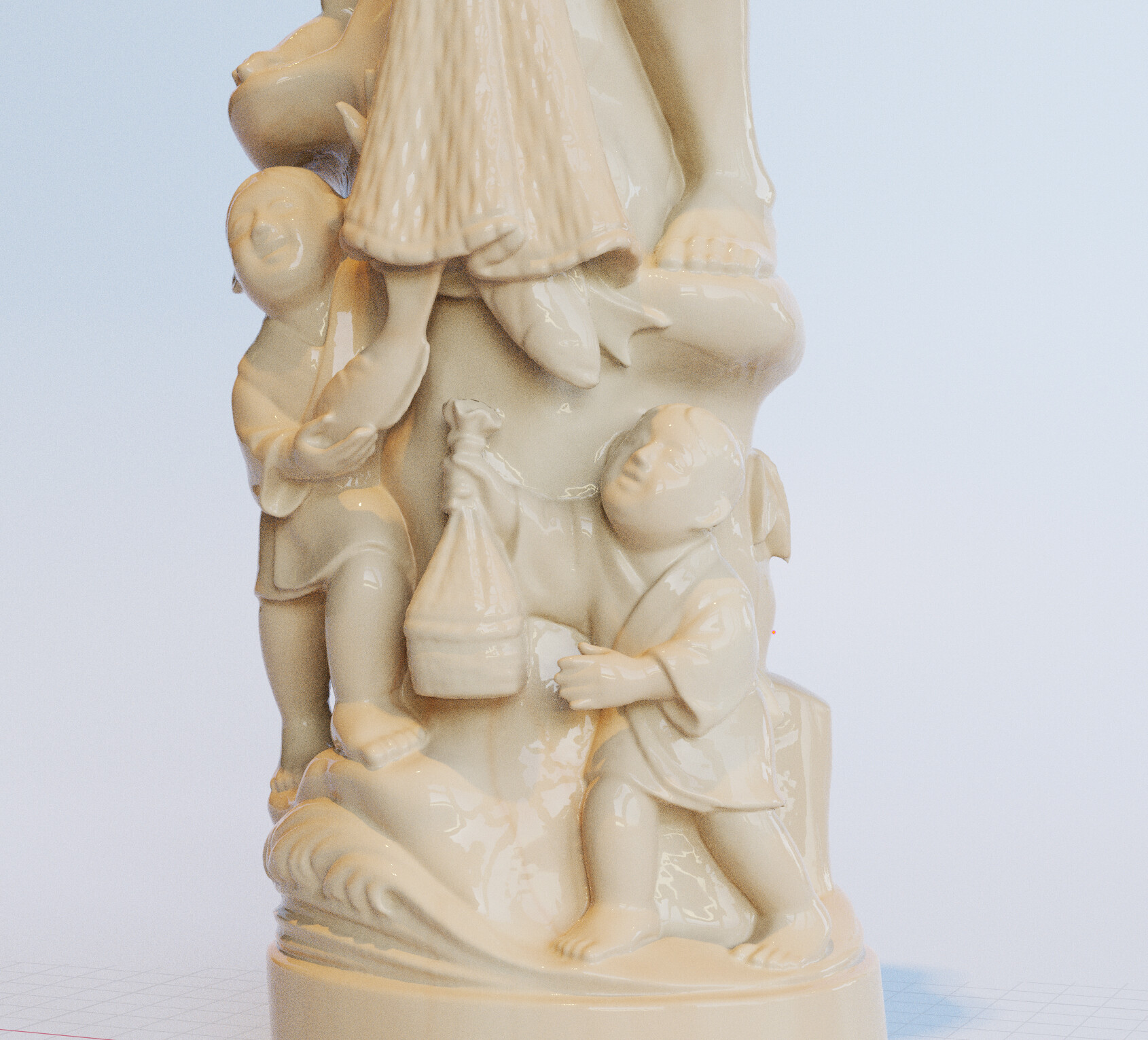
Close-up

Beauty render

Greyscale